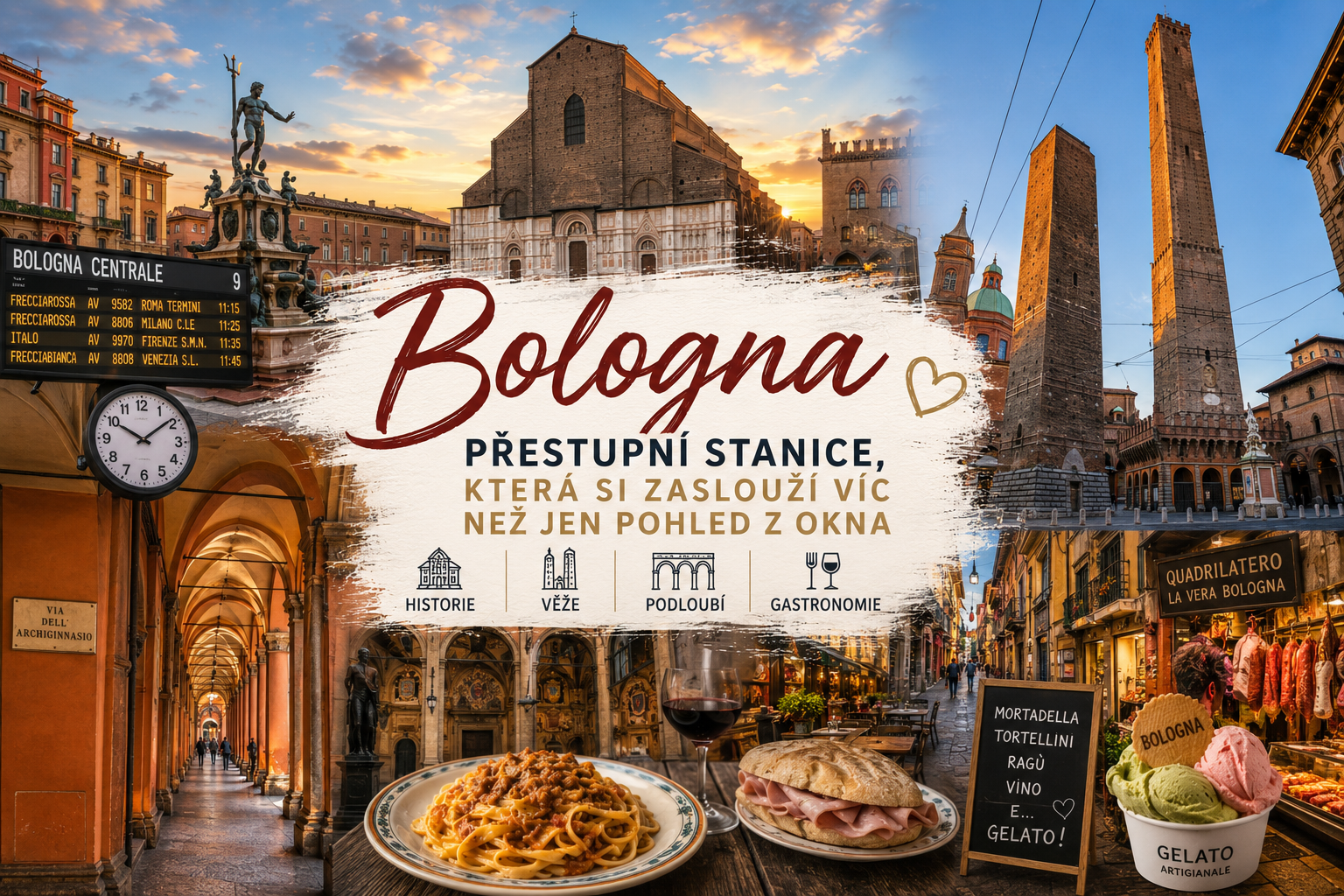
The journey from Rimini to Rome passed through Bologna, and since I'd left myself a few extra hours between train connections, I decided to at least take a quick look around the center. Bologna isn't just a transit point on the way between northern and southern Italy — it's a university city with its own distinctive atmosphere, one that truly lives up to its nicknames "La Dotta" (The Learned), "La Grassa" (The Fat), and "La Rossa" (The Red).
Piazza Maggiore and Its Surroundings
The heart of the city is Piazza Maggiore, which flows seamlessly into the adjoining Piazza del Nettuno with its striking Fontana del Nettuno. The square is also home to the Basilica di San Petronio — one of the largest churches in the world, whose unfinished stone façade still reveals to this day that construction was never fully completed.
The Two Towers
The symbol of Bologna is a pair of leaning towers, Torre degli Asinelli and Torre della Garisenda, affectionately known by locals as the "Two Sisters." The taller of the two, Asinelli, stands over 97 meters high and requires climbing almost 500 steps — but the view from the top over the city's red rooftops is well worth the effort.
Porticoes and the University District
Bologna is famous for its porticoes, which stretch for dozens of kilometers and are listed as a UNESCO World Heritage site. A walk beneath them along Via dell'Archiginnasio, connecting Piazza Maggiore with Piazza Galvani, is one of the loveliest things the city has to offer. It's also worth stepping inside the Palazzo dell'Archiginnasio, the university's original seat, now a library with an impressive anatomical theater.
Anyone with extra time can wander into the Quadrilatero district — an old market quarter of narrow lanes, traditional shops, and wine bars that still feels as lively as a medieval marketplace.
Food
Bologna is, without exaggeration, a gastronomic paradise — this is where ragù (known to us as Bolognese sauce), mortadella, and tortellini all come from. Even with just a few hours between trains, it's worth stopping for a quick lunch at one of the traditional osterias in the center.
A Practical Tip
Bologna's city center is compact and can comfortably be covered on foot in under an hour, so even three hours between connections is enough to get at least a basic feel for the city. Bologna Centrale train station is practically within walking distance of the historic center, so there's no need to worry about complicated transport.
Unfortunately, I didn't manage to fit in the famous Gelato Museum this time — but that's a full-day visit, so I'm saving it for next time. Bologna is definitely worth coming back to with more time on hand.
Comments (0)
No comments yet. Be the first to share your thoughts!
Leave a Comment